"I Was Thousands of Miles Away, Still Broke, Still Struggling — And I Found a Way to Make My Mother Feel Like The Most Loved Woman Alive. Here Is Exactly What I Did."

You love your parent. You have always loved them. That has never been the question.
The question — the one that sits in your chest on quiet evenings and follows you onto the bus in the morning — is this: do they know it?
Not the kind of knowing that comes from paying school fees or sending money home when you have it. The kind of knowing that stays. The kind a parent carries into their final years and draws warmth from when the house is quiet and the children are far away.
You think about calling. You mean to call. Some days you even pick up the phone, scroll to their name, and then put it down again because you are tired, or because you do not know what to say beyond the usual, or because six minutes of "I'm fine, you're fine, God will provide" does not feel like enough — and yet you do not know how to make it more.
So you tell yourself you'll try again this weekend.
Maybe you are in Manchester, or Brampton, or Lagos. Maybe you are working two jobs and by the time you get home you are a shell of a person with nothing left. Maybe you are still finding your feet, still broke, still building — and every time you see a sibling send money home or a friend post a video visiting their parents, something tightens in your chest that you cannot fully name.
You know what you want to do. You want to make your parent feel like the most important person in your world. You want them to feel seen. You want them to know — not just sense, but know — that you think about them, that you are proud to be their child, that the years they gave up and the things they sacrificed were not wasted.
But you keep saying I'll do more when I'm more stable. When I have money. When I visit. When things calm down.
Here is what nobody tells you: things do not calm down. And your parent is not waiting for your finances to stabilise before they get older.
Right now, somewhere, your parent is telling someone about you. They are telling a neighbour or a church member or a sibling what you are doing with your life. They are proud in ways they may never say to your face. And they are also quietly, privately wondering — in the way that Nigerian and African parents wonder without ever asking — whether you know how much they love you. Whether you will carry them with you. Whether the distance means you have drifted.
And you are on the other side of that distance doing the same wondering in reverse.
This is not a story about bad children. You are not a bad child. The problem is not love. Love has never been the problem.
The problem is that nobody ever taught you how to cross the gap between love that lives inside you and love that your parent can actually feel. Nobody gave you the words. Nobody built you a system that works from where you are, with what you have, in the time you actually possess.
That changes today. Keep reading.

My name is Amara. And for four years, I was the daughter who called every Sunday.
I lived in Manchester. My mother lived in Ibadan. Every Sunday evening, Nigerian time, I would dial her number. She would answer on the second ring. I would ask how her body was. She would say she was managing. She would ask if I had eaten. I would say yes. She would tell me to take care of myself, say God would bless my hustle, and we would hang up.
Seven minutes. Every Sunday. For four years.
I told myself this was enough. I told myself I was consistent. I told myself the money I sent when I could manage it made up for the visits I could not afford. I was working at a care home, then picking up extra shifts at a supermarket on weekends. I had nothing left by Sunday evening except enough to dial and enough pride to pretend the call had meaning.
I kept waiting until I was stable. The stable never came. And my mother kept getting older.
I did not see the signs at first. It was my aunt who called me — not my mother, my aunt — to say that Mummy had stopped going to the market herself. That she sat in the parlour most mornings. That she had started repeating herself on calls, asking questions she had asked the week before. My aunt said she thought I should know.
I hung up and sat in the tiny kitchen of my Manchester flat for a very long time.
I tried calling more often after that. Monday, Wednesday, Sunday. Same seven minutes. Same "I'm fine, don't worry, face your work." My mother had been trained over sixty-something years not to be a burden to the people she loved. She was not going to break that habit for my sake. Her stoicism was her love language, and I did not have the tools to translate it.

I tried sending gifts. For her birthday I saved for three months and ordered a food hamper delivery in Ibadan. She called to say thank you. The call lasted four minutes. The hamper went into the kitchen. Nothing changed.
I tried planning a visit. December 2022 was the year. Then it was December 2023. The flights were too expensive. The leave was not approved. Something always happened. Every broken promise left a small residue of shame that made the next call harder to make.
I remember the night I sat on the floor of my bathroom in Manchester and typed into Google, at about 1am: "how do I make my mother feel loved when I am far away and have no money." I found articles about quality time and meaningful conversation. None of them mentioned a Nigerian mother who answered every direct emotional question with a redirect to God's will and a reminder to eat properly.
I was about to give up on finding anything useful when a woman in a Facebook group I belonged to — Nigerians in Greater Manchester — posted something that stopped me completely. She had lost her father three weeks earlier. She wrote: "He used to call me every Tuesday. I was always too busy to talk properly. I kept saying we would have the real conversation when I went home at Christmas. He died in October. I never went home at Christmas. Please. Please. If your parents are still here, don't wait."
I read that post four times. Then I read it a fifth time.
I did not sleep that night. Instead, I started writing down everything I wished I had said to my mother. Every question I had never asked. Every story I had never heard. Every "thank you" that had lived in my chest for years without ever finding her ears.
Over the following weeks I obsessed over this. I read everything I could find about aging parents, about what elderly people actually need emotionally, about what makes a person feel truly seen. I looked at the research on connection. I spoke to older Nigerian women — aunties and family friends — and asked them directly: what do your children do that makes you feel most loved? Their answers surprised me. None of them said money. None of them said visits, though they loved visits. What they said, again and again, was this: when they remember things about me. When they ask me questions no one else asks. When I can hear in their voice that they are thinking about me — not just checking on me.
I began building a system. Slowly, imperfectly, one action at a time.
The first thing I did was send my mother a voice note. Not to say I was fine. To say something real. Sixty-eight words that I had rehearsed three times before recording. I told her about a specific morning when I was eight years old when she had combed my hair before school and I had been difficult about it, and how I had never forgotten how patient she was, and how I thought about that patience every time I felt impatient with someone at work.
She called me back in eleven minutes.
The call lasted forty-four minutes. She told me things about herself I had never heard. About how she had been nervous about having a daughter. About how she had prayed over me every night when I was small. About how proud she was — and she used that exact word, proud, a word I had never heard her say to me directly in thirty-one years of life.
I sat with the phone against my chest after we hung up and cried in a way I had not cried since I was a child. Not from sadness. From something that felt like relief. Like a debt I had carried for years had been partially, finally, paid.
That was the beginning. Over the following months I refined the approach into something repeatable. I tested what worked and what did not. I started sharing it with friends who were going through the same thing — Nigerian women in Manchester, a friend's brother in Toronto, a cousin in Lagos who lived thirty minutes from his parents but felt just as far away emotionally. Every single person who tried it reported the same thing: their parent responded. Often within hours. Sometimes within minutes.
The system worked not because it required money, or travel, or dramatic gestures. It worked because it gave love somewhere to land. It replaced seven-minute calls that said nothing with ten-minute calls that said everything. It did not require a warm, emotionally demonstrative parent — it worked on the quiet ones, the stoic ones, the ones who showed love through food and silence and early morning prayers sent over WhatsApp.
I packaged everything I built into one guide. Every action, every script, every question, every daily ritual. Two tracks for every day — one if you live nearby, one if you are thousands of miles away. And I called it what it is.
30 Days to Make Your Parent Feel Completely Loved
— So When They're Gone, You Feel Only Peace
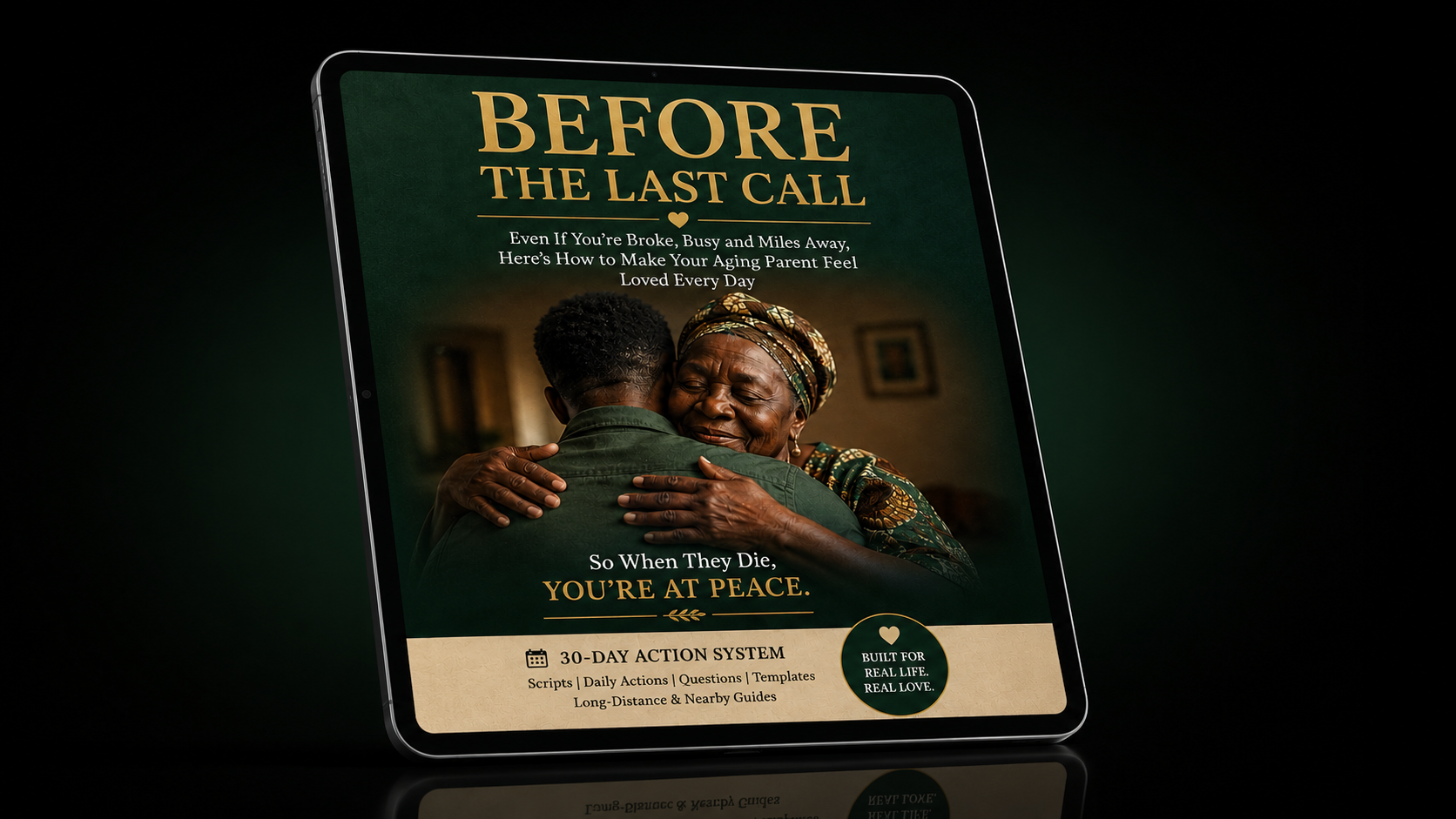
Everything You Need to Cross the Gap Between Love Felt and Love Actually Received
Before you can give love that lands, you have to dismantle the lies that have been blocking it. This section exposes the three beliefs that keep most adult children stuck — that love requires money, that it is too late to start, and that your parent does not really need this from you. One by one, each belief is taken apart and replaced with a truth that makes action possible today. This phase also includes the Difficult Parent section — a dedicated track for children whose parent was not warm, not safe, or not easy to love, because no other guide has ever acknowledged that this version of the story exists. You will leave Phase 1 knowing exactly why you have been paralysed and exactly what is possible starting from Day 1.
This is the engine of the guide. Sixteen daily actions, each with two complete versions: Track A for children who live nearby or can visit, and Track B for children who are abroad or can only reach their parent by phone or WhatsApp. Every single action comes with a word-for-word script. Not a suggestion. Not a concept. The exact words to say, when to say them, and what to do with the silence that follows. The actions escalate gradually in emotional depth — starting with small, safe moves on Day 9 and building toward the kind of conversations most Nigerian families have never had. By Day 24 you will have said things to your parent that you have carried inside you for years. And they will have responded in ways you did not know were possible.
The goal is never thirty days. The goal is the rest of your parent's life. Phase 3 installs five permanent weekly rituals so small and so well-designed that you will still be doing them three years from now without thinking. It also guides you through completing the Family Story Archive — a living record of your parent's memories, wisdom, and life that you will carry forward when they are gone. And it ends with the Parent's Love Letter: a piece of writing you give to your parent while they are still alive, that they can hold, re-read, and return to. This is the thing they will show people. This is the thing they will keep.
Fifty culturally specific conversation starters built for Nigerian and African family dynamics — for parents who redirect, deflect, or answer every question with a Bible verse and a subject change. These are not generic therapy questions. They enter through the side door. They ask about a memory, or a time, or a feeling that happened forty years ago — and in answering, your parent says the thing they have never said. You ask what your father was proud of before you were born and he speaks for twelve minutes. You ask what your mother was afraid of when she first became a parent and she tells you a story you will think about for the rest of your life. Each question in this bank is a key to a room in your parent's interior world that you have never entered.
Twenty complete phone and voice note scripts for the moments that matter most — the ordinary Tuesday call that becomes extraordinary, the birthday message that finally says what you have always meant, the voice note that makes your parent play it three times and then call you back, the WhatsApp message that arrives on a random Wednesday and makes your parent feel like the most important person in your world. Each script is 40 to 80 words. Each one is ready to use. You personalise three details and send. That is it. No performance required. No emotional vocabulary you do not have. Just the words, already written, waiting for your parent's name.
For the child whose parent was hurtful. Who was absent. Who was cold, or controlling, or who delivered love wrapped in criticism for so long that the child stopped being able to feel it. This supplement does not ask you to pretend the hurt did not happen. It does not ask you to perform a warmth you do not feel. It gives you a modified protocol — smaller actions, longer timelines, softer entry points — that honours both your parent's declining years and your own right to love them on your terms. Because your parent not having been easy does not mean you have to stop being the kind of person who shows up. It just means you need a different map.
Most advice about connecting with aging parents is built on one assumption: that you have time, money, and an emotionally open parent. Take the kids to lunch. Plan a holiday together. Have an honest conversation about how you feel.
That advice was not written for you. It was not written for the young adult who is still building their financial life. It was not written for the diaspora child whose parent is an ocean away. It was not written for the person whose Nigerian parent considers emotional directness a kind of weakness. And it was certainly not written for the child whose parent has never once said "I love you" out loud but showed it by waking at 4am to pray over you before school.
Before The Last Call is built on a different foundation entirely. It is built on what aging parents have actually said they need — in their own words, unprompted — when asked what their children do that makes them feel most loved. The answer is never the biggest thing. It is always a small, specific, repeated thing. A question that shows the child was listening. A message that proves the parent is thought of on ordinary Tuesdays, not just birthdays. A moment of genuine attention in a world that has learned to substitute financial provision for emotional presence.
The dual-track architecture means no action in this guide requires you to be in the same room, the same city, or the same country as your parent. Every single thing works from a phone. From a WhatsApp message. From sixty seconds of attention in the middle of a depleted day. And because every action comes with exact scripts, you never have to stand in front of a blank page wondering what to say to the person who raised you.
The result is not one dramatic conversation that fixes thirty years of distance. The result is a new pattern. A rhythm. A relationship your parent can feel building week by week. And when they are eventually gone — when the last call finally comes — you will not be standing at a graveside wondering what you left unsaid. Because you will have said it. All of it. In thirty days of ten-minute actions that cost you nothing except the willingness to begin.
Just So You Know, Putting This Guide Together Cost Me Over ₦87,000
This was not a weekend project. Building something that actually works — that is grounded in real buyer research, tested with real people, written with precision, and formatted properly — takes real investment. Here is where the money went.
| Deep market research and buyer interviews | ₦25,000 |
| Writing and content development | ₦20,000 |
| Editing and proofreading | ₦12,000 |
| Design, layout and formatting | ₦15,000 |
| Software, AI tools and production resources | ₦15,000 |
| Total investment | ₦87,000 |
I am not telling you this to impress you. I am telling you because you deserve to know what is behind the price. And because what you are about to pay is a small fraction of what this cost to build.
What Happened When They Finally Showed Up
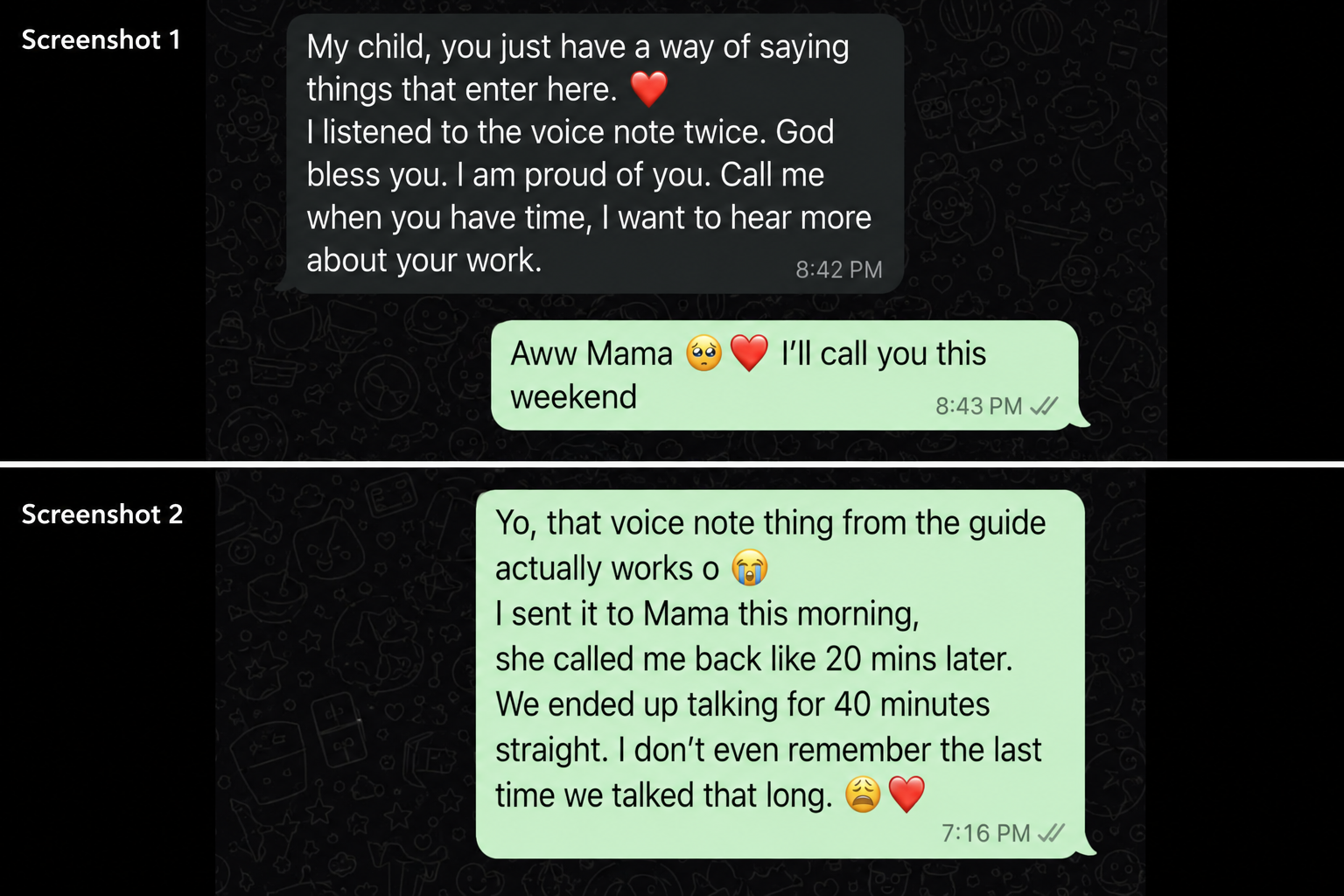
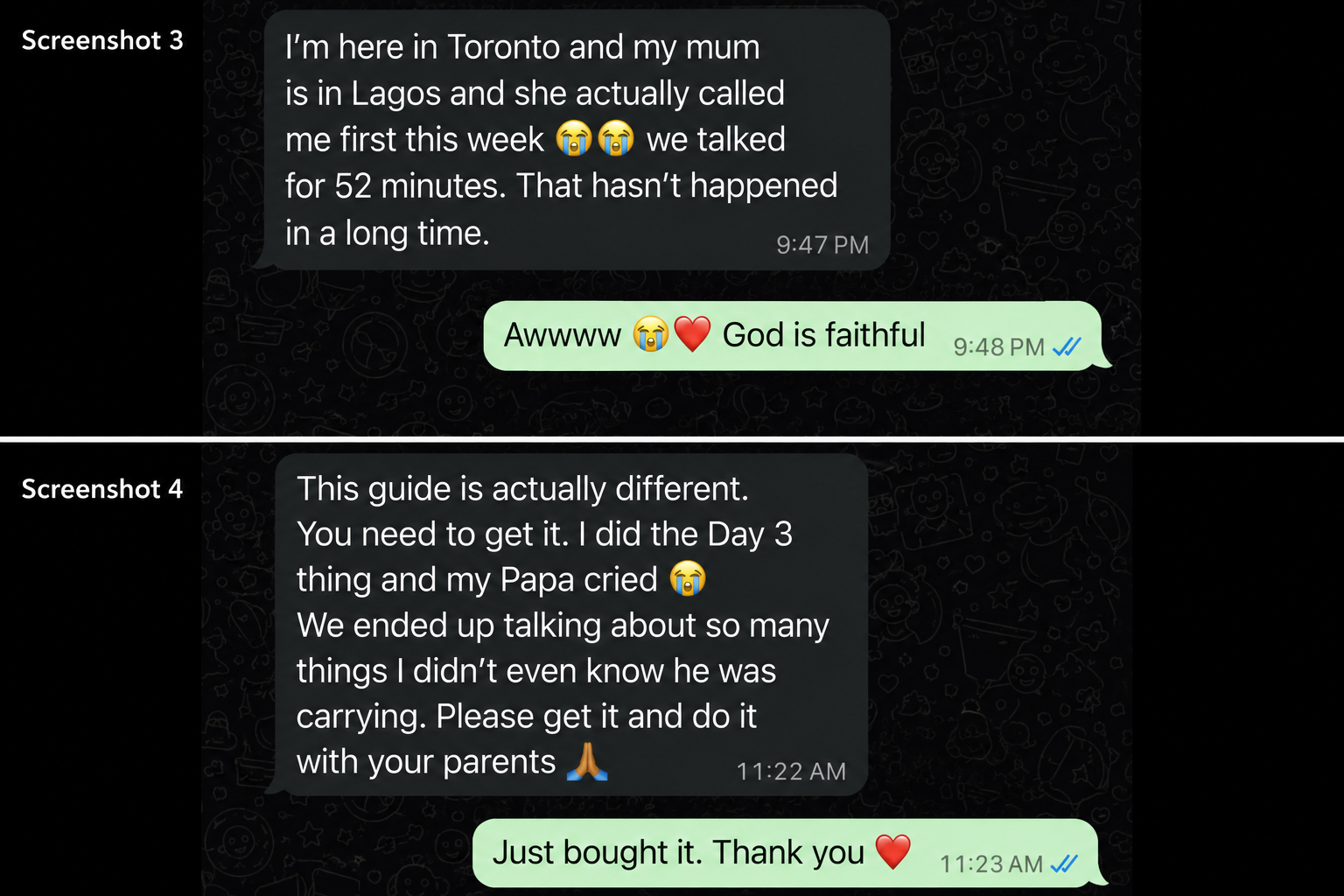
You Would Expect to Pay a Lot More for This.
And You Would Be Right.
That is less than a plate of rice and stew at a restaurant in Lagos. Less than one data recharge. And it gives you everything — the 30-day protocol, the call scripts, the story bank, and both bonuses.
Get Instant AccessYour parent is still here. That is the only thing that matters right now.
Get Instant AccessYou Get Two Powerful Bonuses
At No Extra Cost
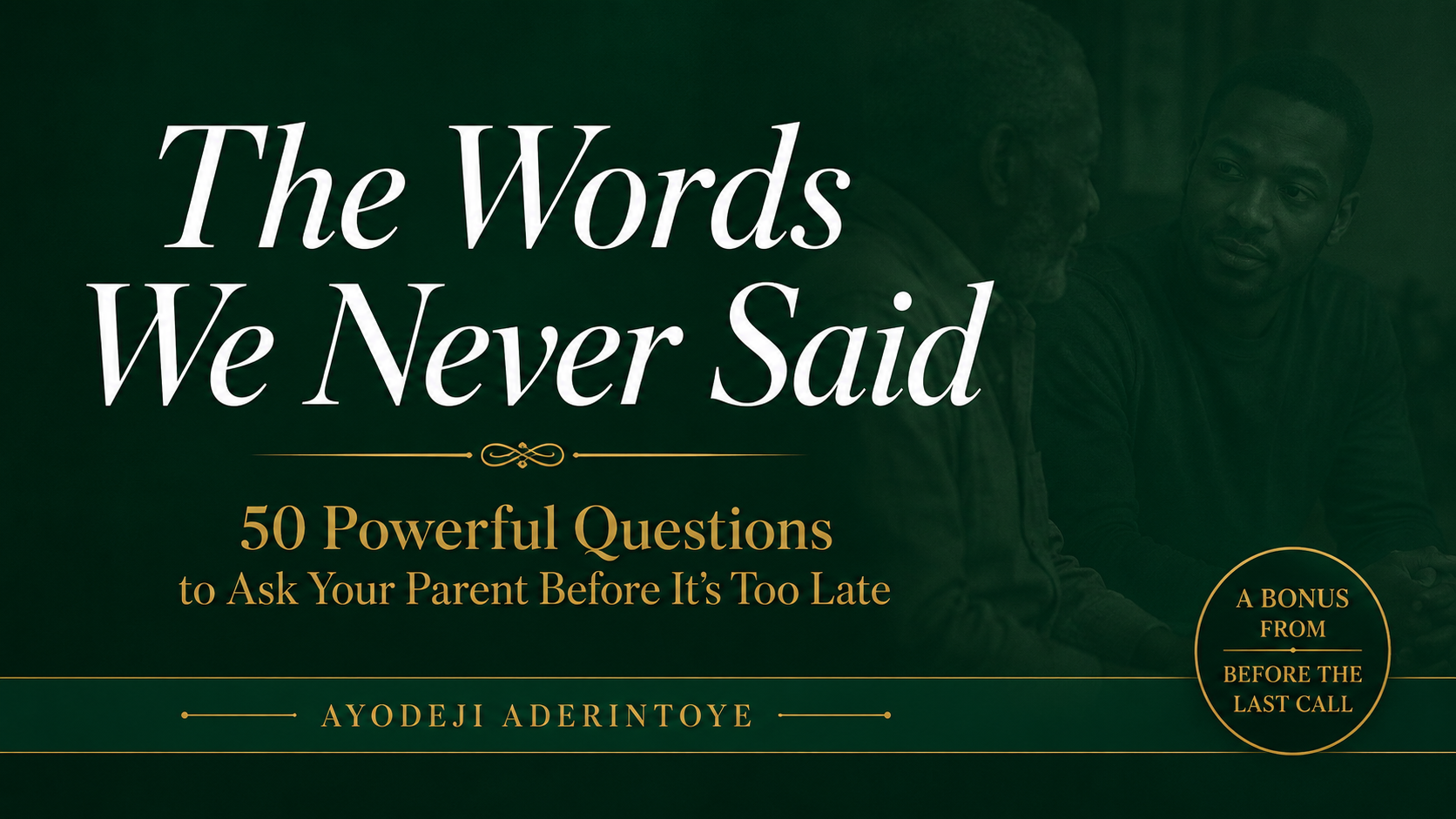

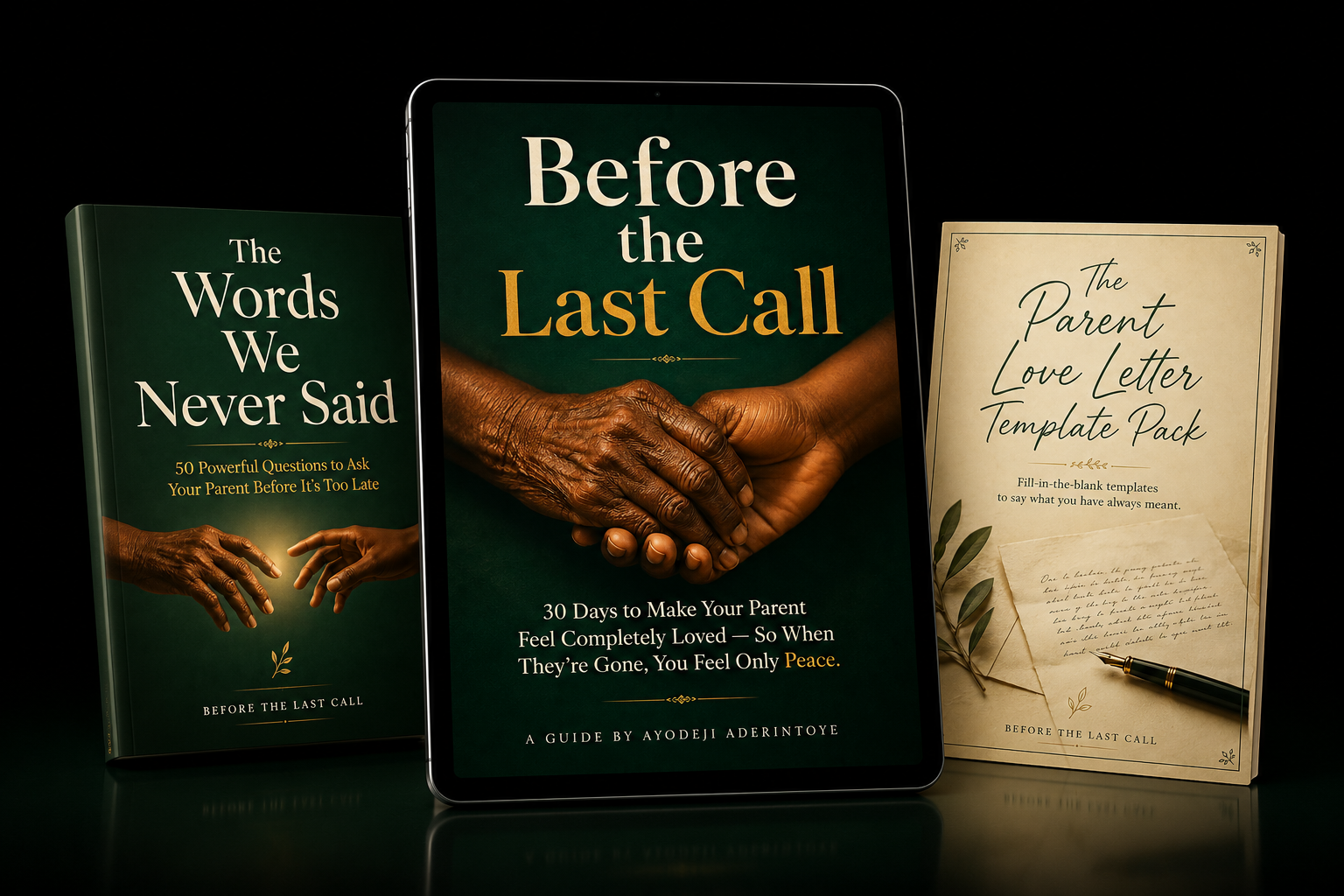
Everything included for just ₦4,999
The guide + 50 Questions Bonus + Love Letter Templates. Delivered to your inbox in seconds.
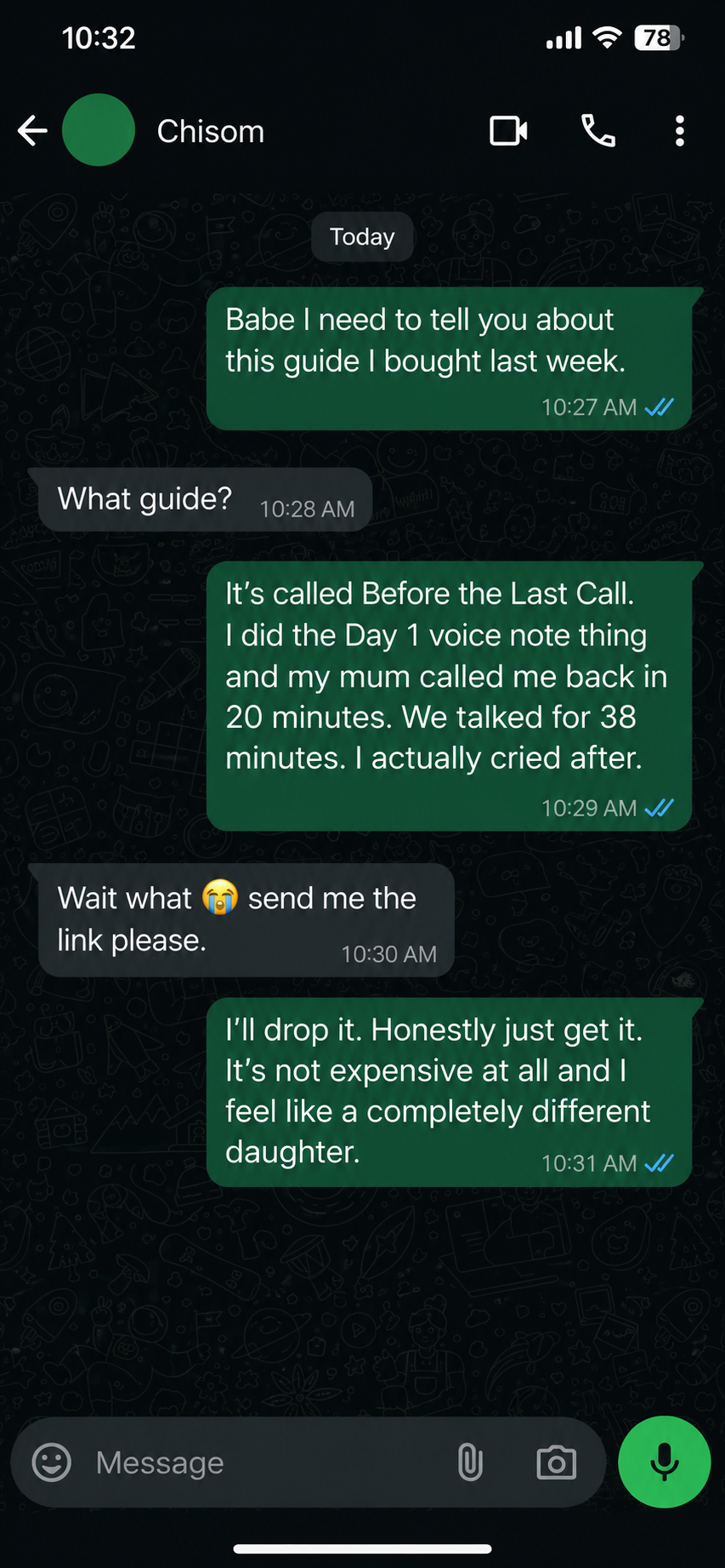
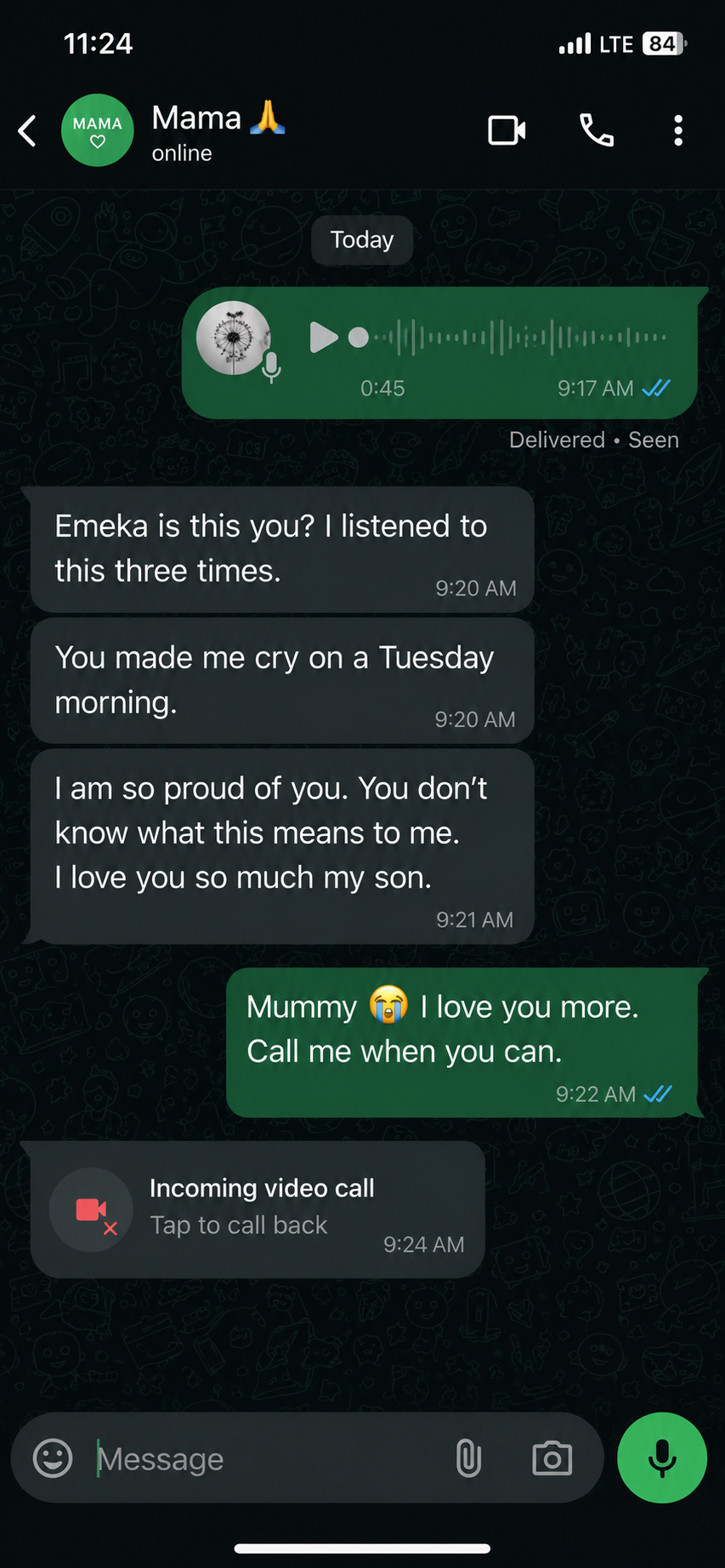
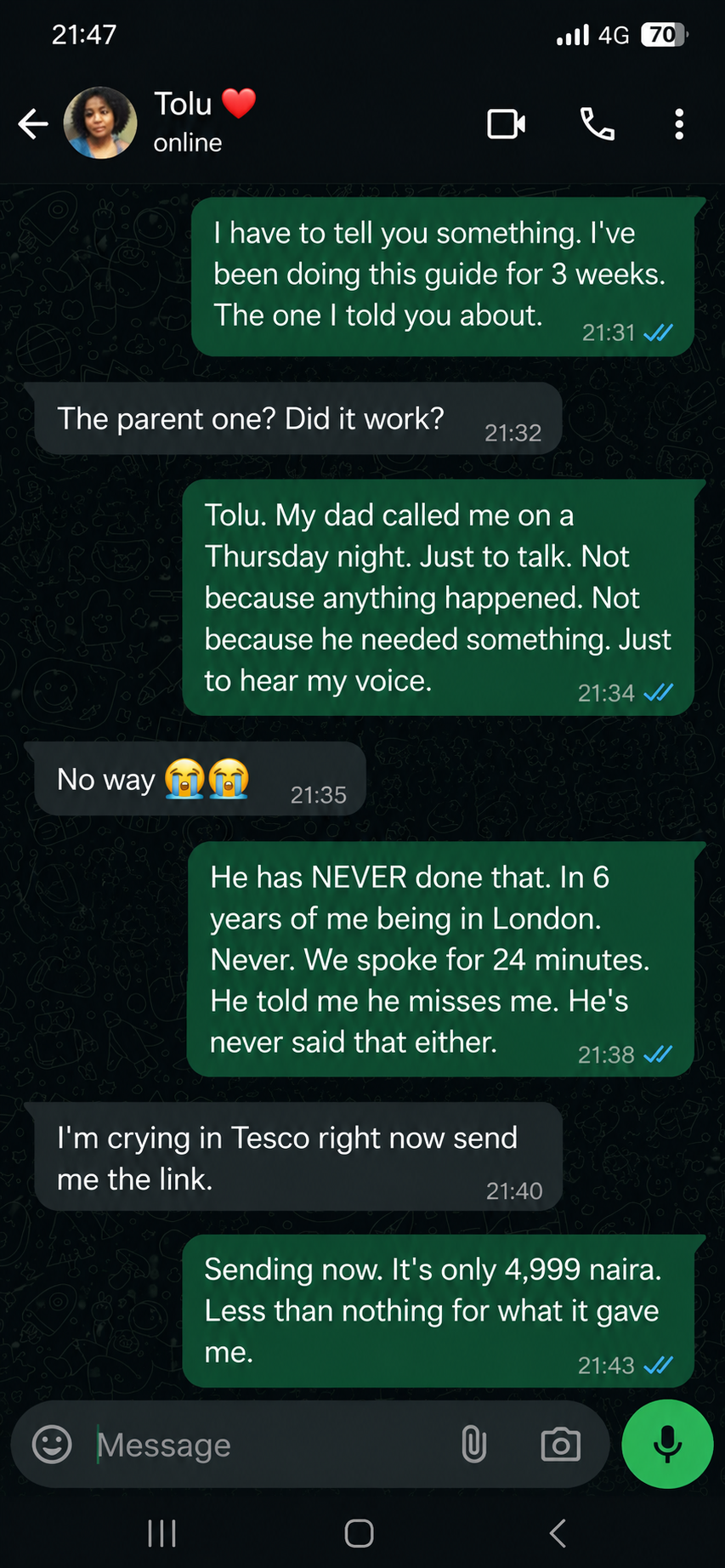
Get Instant Access + FREE Bonuses NowMore Real Messages from Real Buyers
My Complete Peace-of-Mind Promise
Go through this guide. Do the actions. Use the scripts. Send the voice notes. Have the conversations.
If at the end you feel it was not worth every naira — contact me. I will refund you in full, no questions asked, no bad feelings. You do not need to explain yourself.
I am confident enough in what is inside this guide to make that promise without hesitation. Because I have seen what happens when people actually use it.
Quick Answers
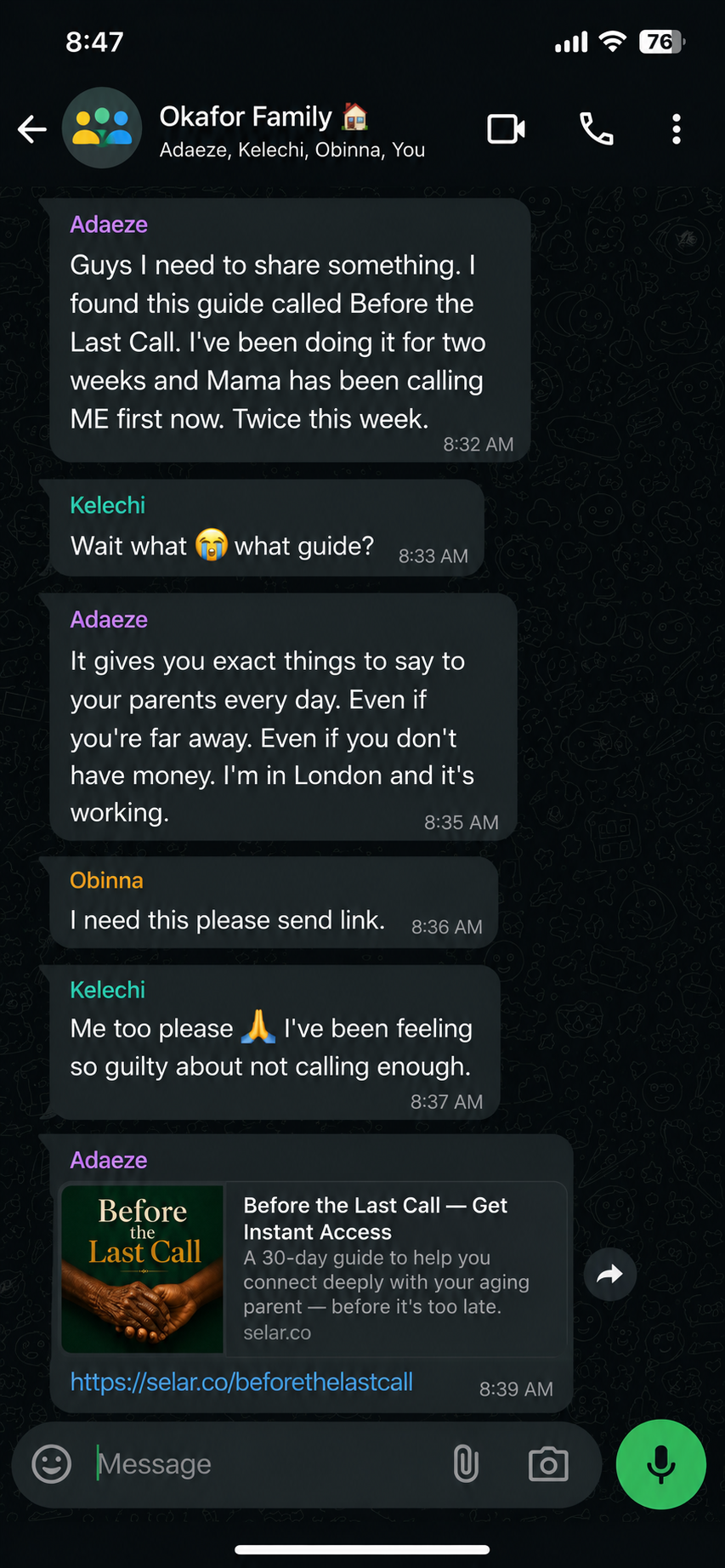
More People Who Stopped Waiting and Started Showing Up
Two Roads. One Choice. No In-Between.
You already know which road feels right. You have known it since the first paragraph of this page. The guide costs less than a meal out. Your parent's remaining years cost everything.